

1. Oil Price Shocks: Fallout from the War with Iran
Before the U.S. war with Iran, the Strait of Hormuz handled roughly one-fifth of global oil shipments.
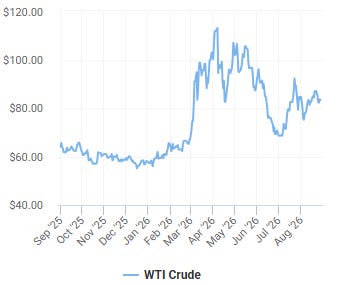
The conflict’s disruption to the Strait’s operation has affected global oil supply, sending U.S. West Texas Intermediate (WTI) crude from $67 per barrel before the war broke out, to a peak of nearly $113 in early April.
Although WTI has since declined to just over $80, it remains roughly 24% above its pre-war level.
2. Dwindling US Strategic Petroleum Reserve
To insulate Americans against the US-Iran-war induced oil price shock, the U.S. president authorized the release of 172 million barrels from the Strategic Petroleum Reserve (SPR).
As of August 21st, approximately 290 million barrels remained in the SPR, the lowest level since 1982.
The SPR exists as an emergency reserve to cushion the U.S. against major supply disruptions in case of natural disasters or geopolitical conflicts.
If the conflict worsens and produces another oil price shock, the U.S. government might need to draw down the reserve further to soften the impact on American households.
The U.S. therefore has considerably less emergency oil available to weather any further disruption in supply.
3. Enter Canada: the U.S.’s largest foreign source of crude oil
While the U.S is the world’s largest oil producer, it is also the world’s largest consumer, which means it continues to rely heavily on imported crude oil.
And no country supplies the U.S. with more crude oil than Canada. In 2025, a little over 60% of U.S. crude oil imports were supplied by Canada.
Most people would agree that a period of historically low strategic oil reserves, coupled with ongoing disruption to global oil supply that could worsen, is an unfortunate time to pick a fight with your largest foreign crude oil supplier.
4. And the U.S. Midterms are just over 2 months away
Republicans are heading into the November 3 midterm elections under intense pressure as affordability concerns remain top of mind for Americans.
The pressure is clear as Trump, who himself ran under the banner of affordability met with refiners and fuel retailers on August 27 to discuss bringing down fuel prices. U.S gas prices are currently at $4 per gallon, about $1 higher than a year ago.
There is therefore ample political incentive to draw further from the SPR if another oil price shock sends gas prices higher. Although oil released under the emergency release program will eventually be returned, a low strategic reserve poses its own risks.
In addition to gas prices, inflation and interest rates are also putting considerable pressure on US household finances.
5. U.S. Inflation Remains Stubbornly High
Inflation remains a problem in the U.S. as the rate of price increases remains well above the 2% target. In July, personal consumption expenditure (PCE) inflation came in at 3.7%.
Not only could further oil supply shocks push prices higher, the newly imposed tariffs on Canadian goods create an additional source of inflationary pressure on U.S. prices.
Starting another trade war while struggling with stubbornly high and above-target inflation increases the likelihood that the federal reserve will need to keep its policy interest rate elevated for longer.
Or potentially even raise rates further. Which will put even more pressure on household borrowing costs.
6. US Interest Rates Weighing on Americans
American households are already contending with high borrowing costs. The average 30-year mortgage rate was 6.66% as of August 27, up from 6.56% a year ago.
Meanwhile, the rate charged on U.S. government debt remains elevated due to increasing government borrowing, and persistent inflation among other factors.
As inflation remains stubbornly high, markets have increased expectations of a rate hike following Federal Reserve Chair Kevin Warsh’s August 28 comments that policymakers would have “work to do” if underlying inflation is not clearly returning to 2%.
That would put further upward pressure on the cost of borrowing for American households, businesses, and the U.S. government.
7. This is personal for Canadians
After replacing the 26-year-old North American Free Trade Agreement (NAFTA) with the USMCA during his first term, Trump is once again looking to negotiate the trade agreement he himself repeatedly described as “the best trade deal in the history of trade deals”. All while ridiculing and questioning Canada’s sovereignty
After Prime Minister Carney walked away from the latest negotiations rather than accept the U.S. terms, 76% of Canadians said he made the right decision. This is despite almost 40% of Canadian workers expressing some anxiety about the impact of the trade dispute on their own jobs.
And this goes beyond polling, Canadians are putting their money where their mouth is.
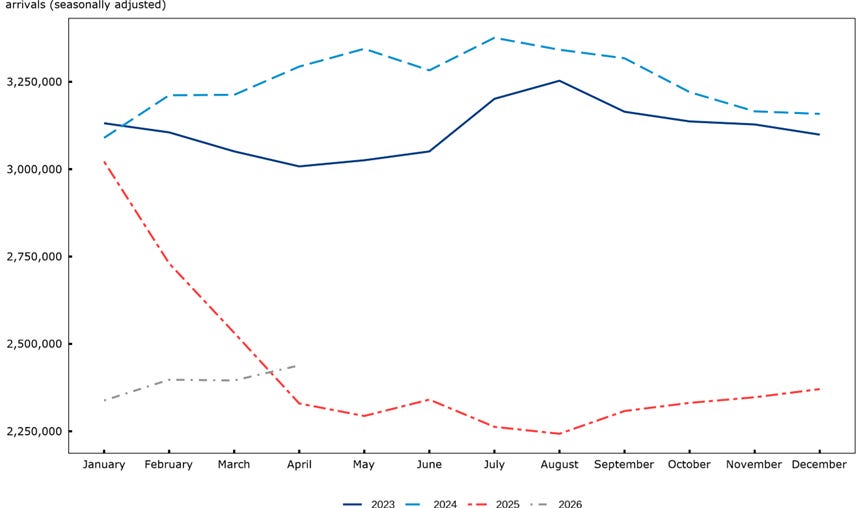
Canadian residents have significantly reduced their trips to the U.S. since the trade conflict began. Canadian return trips from the U.S were down 25.4% in 2025 compared to 2024, and has since remained depressed.
Canadian consumers have also changed their buying habits. 40% of Canadian grocery shoppers say they actively check country of origin, and among those who check, most say they put American products back in favour of Canadian or non-U.S. alternatives.
Despite 89% of Canadians expressing concern over the impact of tariffs on costs, 62% support dollar-for-dollar retaliatory tariffs.
The Canadian government has also stated plans to provide support to impacted businesses.
All of which makes economic pain politically easier for Ottawa to sustain than Washington may be assuming.
“This is personal for Canadians.” I do hope this holds. The Canadian economy is so dependent on US trade that there will be economic hardship that might put pressure on the PM and his cabinet to sign a bad deal. I do worry about AB and SK provincial governments undermining the federal government strategy. On the bright side, the economy growing at 3.3% in Q2 and impressive upcoming investments might give Canada just enough cushion to weather the uncertainty, I hope.